

Amazon
Brand Registry
Catalog & Compliance
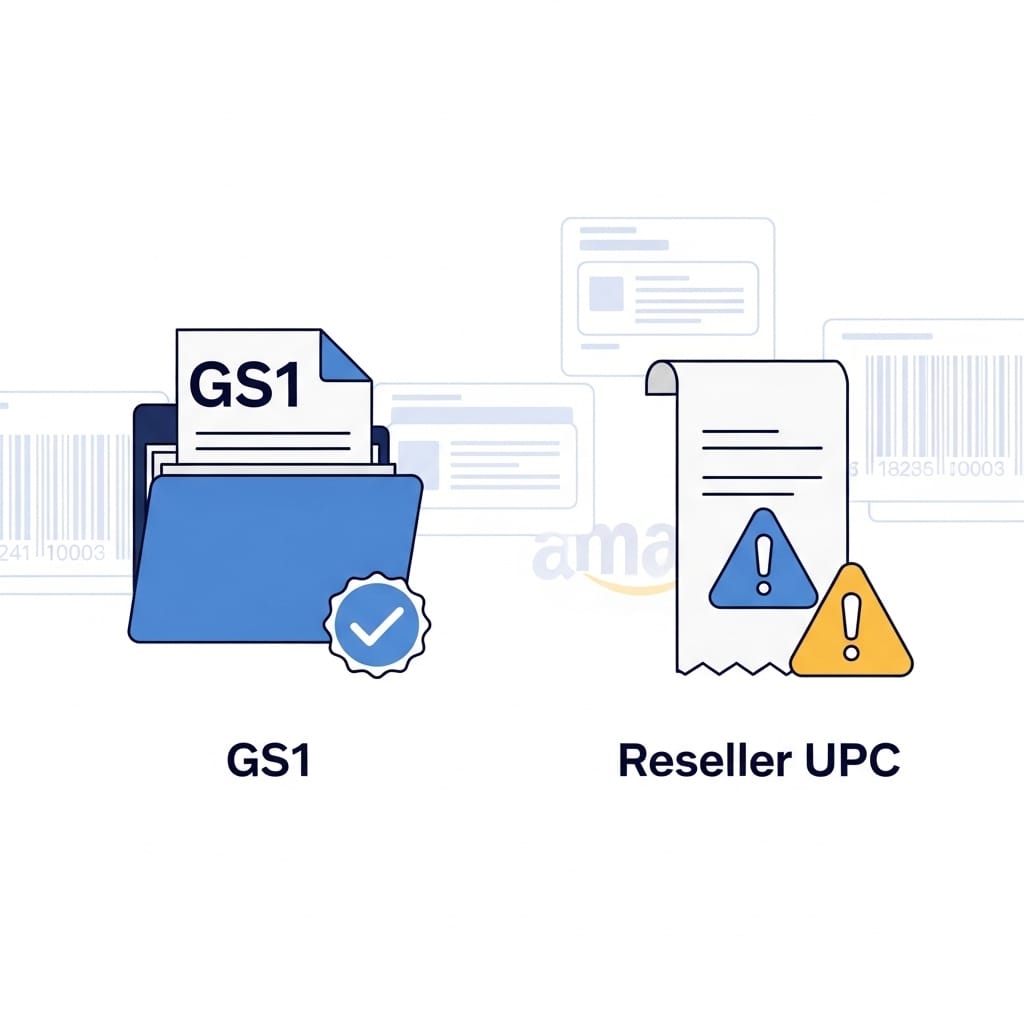
GS1 vs Reseller UPC Codes for Amazon: What Brand Registered Sellers Need to Know
If you’re Brand Registered and selling your own branded products, buying “cheap UPCs” from a reseller can feel like a smart cost-saving move. The problem is that Amazon’s catalog systems care less about whether a barcode image scans and more about whether the GTIN (UPC/EAN) is valid and consistent with the brand and data Amazon expects.
Kascadian recommendation (for Brand Registered brands)
For new SKUs, use GS1-licensed GTINs so your company is the legitimate license holder. Reseller UPCs sometimes work, but you are accepting a meaningful risk of listing creation issues, catalog contribution problems, or later enforcement changes.
The 60-second answer
If you are Brand Registered (and building a real brand)
Buy GTINs from GS1. It’s the most durable, lowest-risk path for Amazon catalog health and multi-channel growth.
If you’re running short tests (Amazon-only) and eligible
Consider a GTIN exemption and use FNSKU labeling for FBA, understanding it depends on category/brand setup and can limit reuse for retail later.
If you buy reseller UPCs
You may save money up front, but you’re accepting the risk of GTIN/brand mismatch, blocked contributions, suppressed listings, or future rework (relabeling, new ASINs, repackaging).
First, let’s define the identifiers (so you don’t solve the wrong problem)
SKU
Your internal inventory code (Shopify, warehouse, accounting). You control it.
GTIN / UPC / EAN
A global trade item identifier used for product identity across marketplaces and retail. This is where GS1 licensing matters.
ASIN
Amazon’s catalog identifier for a product detail page. Amazon assigns/uses this for the catalog record.
FNSKU
Amazon’s fulfillment label identifier used for FBA tracking. Helpful operationally, but it doesn’t replace GTIN product identity in the catalog.
Why GS1 vs reseller UPCs becomes a real problem on Amazon
Most barcode reseller sites emphasize that “a barcode is a barcode” and that their codes are “valid” or “originate from GS1.” The practical issue for Brand Registered sellers is not the black-and-white bars. It’s whether the GTIN is legitimately licensed to your business and aligns with Amazon’s expectations for brand and product identity.
Key distinction
A reseller “certificate of ownership” is not the same thing as GS1 licensing. Even if the number exists and scans, it can still be tied to a different company in GS1 records. That mismatch is where Amazon issues often start.
Common failure modes we see (especially with Brand Registry)
Listing creation blocks
Errors such as “Invalid GTIN” or “GTIN mismatch” when creating a new ASIN contribution.
Brand/GTIN association problems
Amazon may flag inconsistencies if the GTIN appears associated with a different company/prefix, or if catalog data conflicts with expected brand identity patterns.
Catalog maintenance friction later
Edits get rejected, variations become difficult to build/maintain, or contributions become “sticky” and hard to correct without rework.
Suppression and enforcement changes
Amazon enforcement patterns can change over time, by category, and by account. Something that “worked” last year can be flagged later.
“But we use FNSKU labels for FBA anyway” (the common misconception)
FNSKU labels are about fulfillment tracking, commingling control, and operational accuracy in Amazon warehouses. They help you ship units and get them scanned in. They do not automatically resolve GTIN identity requirements for catalog creation, brand consistency, or long-term catalog maintenance.
Put differently: you can cover a UPC on the box with an FNSKU label and still run into GTIN-related issues when you create, update, or expand your catalog.
Decision matrix: GS1 vs reseller vs GTIN exemption
Implementation checklist (Brand Registered + multi-channel)
The goal is to keep your internal SKU system intact while ensuring each sellable unit has a GTIN you legitimately control.
Step-by-step
1) Choose your GS1 issuing organization
Pick GS1 based on your entity/market strategy (commonly GS1 Canada or GS1 US). The key is that your company becomes the license holder.
2) Decide how to purchase GTINs (capacity planning)
If you have only a few SKUs, individual GTINs may be fine. If you expect many products/variations over time, a company prefix may be more scalable.
3) Create a SKU → GTIN mapping sheet
At minimum: Internal SKU, product name, variation (size/color), GTIN, and packaging level (each vs case). This prevents duplicate GTIN usage and variation chaos.
4) Shopify: keep your internal SKU, populate GTIN in the Barcode field
This preserves your internal workflows and improves compatibility with feeds, apps, and future channel integrations.
5) Amazon: align brand naming and variation strategy before scaling
Make sure the brand string and product identity are consistent across the catalog. This reduces contribution conflicts and protects your Brand Registry investment.
6) Labeling: plan UPC placement vs FNSKU workflow
Even if you use FNSKU labels for FBA, you should still treat GTINs as your product identity backbone for catalog integrity and multi-channel readiness.
Already using reseller UPCs? Don’t panic (audit first)
If you have live ASINs already selling, do not automatically change GTINs. Changing identifiers can trigger new-ASIN workflows, create duplicates, or introduce catalog conflicts.
Instead, treat this as a structured risk audit:
Audit
Check whether your current GTINs appear associated with your company or a different entity. If they appear tied elsewhere, assume higher risk for future edits and scaling.
Stabilize
Keep stable, high-performing ASINs as-is unless there is an active issue. Focus on preventing new risk.
Standardize
Move all new SKUs (and any relaunches) to GS1-issued GTINs to future-proof your catalog.
FAQ (Brand Registered seller edition)
Do I need GS1 barcodes for Amazon Brand Registry?
Brand Registry itself is separate from barcodes, but Brand Registered brands are more likely to run into GTIN/brand consistency checks as they scale.
Using GS1-licensed GTINs is the lowest-risk way to keep product identity clean and defensible.
Using GS1-licensed GTINs is the lowest-risk way to keep product identity clean and defensible.
Can reseller UPC codes work on Amazon?
Sometimes, yes. The risk is that they may not be licensed to your company, and Amazon enforcement can vary by category and over time. The more you invest in your brand and catalog, the less that risk tends to be worth it.
What is a GTIN exemption?
A GTIN exemption is an Amazon pathway (category/brand scenario dependent) that can allow listing creation without a standard UPC/EAN. It can be useful for certain cases, but it’s not always available and may be less future-proof for retail or multi-channel expansion.
If we use internal SKUs in Shopify, do we still need UPCs?
Internal SKUs are perfect for inventory control, but UPC/GTINs are external identifiers used for catalog identity and compatibility across channels. You can keep SKUs and still store GTINs in Shopify’s Barcode field for each variant.
If my UPC shows as registered to another company, what does that mean?
It’s a red flag that the GTIN may not be licensed to your business (common with reseller UPCs). That can increase the chance of Amazon contribution conflicts, brand/GTIN mismatch issues, and future maintenance headaches.
Want us to sanity-check your GTIN risk before it becomes an Amazon problem?
Kascadian can audit your catalog identifiers and Brand Registry alignment, then provide a clean SKU→GTIN mapping and rollout plan for Amazon + Shopify.
Disclaimer: This post is general guidance based on common Amazon catalog and identifier patterns. Amazon requirements and enforcement can vary by category and can change over time. When in doubt, choose the option that preserves long-term catalog stability.