

Why the Marketplace Middleman Model Broke
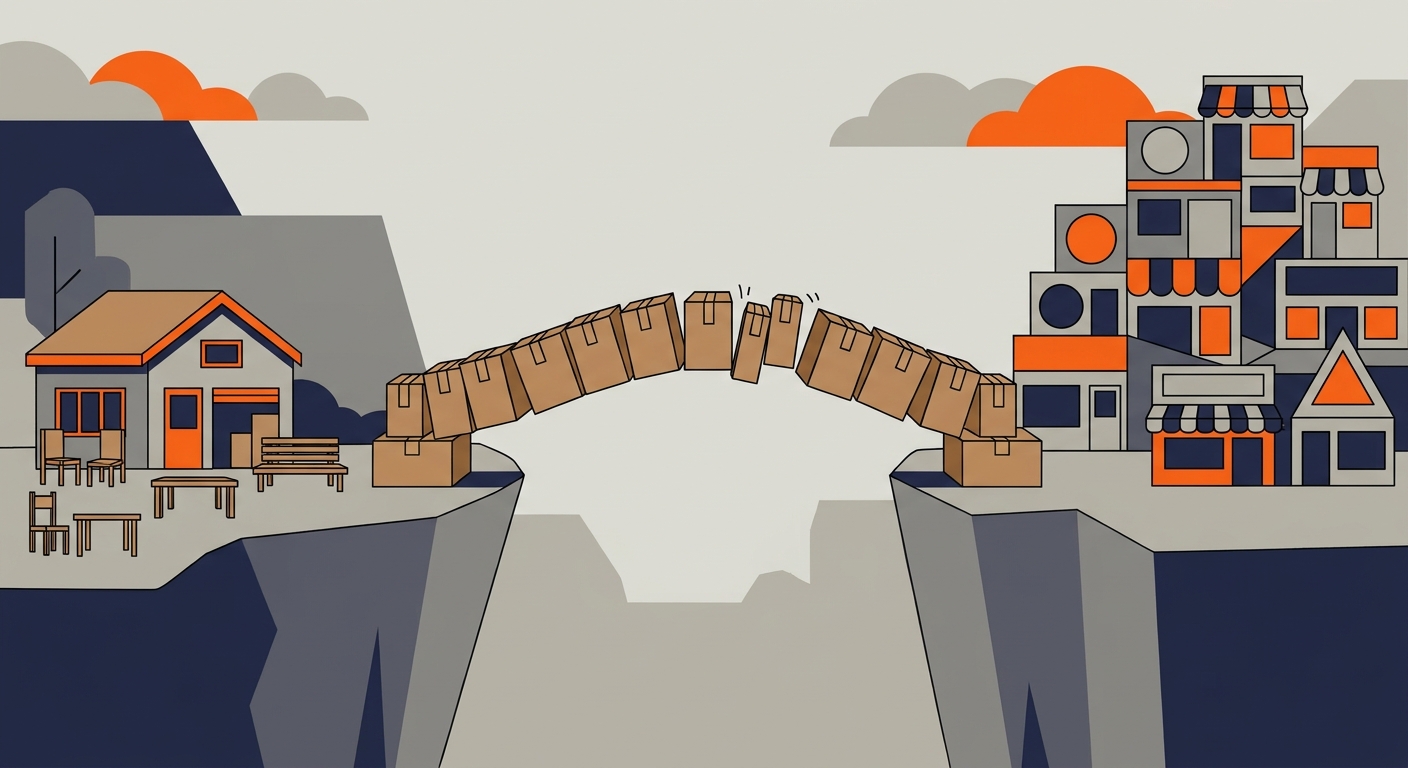
Two Canadian companies that sold furniture on marketplaces on behalf of manufacturers have closed in 2026. Cymax in Vancouver and CommerceBear in Toronto were very different businesses, but they shared one idea: furniture brands would pay someone else to run Amazon, Walmart and Wayfair for them. Here is how that model made money, what changed underneath it, and what furniture brands should take from it.
If you sold through Channel Gate or shipped with Freight Club and need to act now, start with our checklist for Cymax vendors. This post steps back and looks at the bigger picture. It is about a business model, not about any one company's decisions, and where we offer reasoning rather than reported fact, we say so.
Two Closures, One Idea
Cymax Group Technologies was founded in 2004 as an online furniture retailer. Over two decades it became a marketplace seller on behalf of furniture and home-goods vendors, through its Channel Gate platform, and added Freight Club for large-item shipping. The Globe and Mail reported that its monthly sales peaked at US$38 million during the 2020 pandemic boom, and that the company is now closing, with 135 jobs lost and a receivership filing in preparation. Its CEO and majority owner, Markus Frind, told the paper: "It made zero financial sense to carry on. There was no path to recovery."
CommerceBear, founded in Toronto in 2019, built an end-to-end platform for furniture manufacturers to list and sell on Wayfair, Amazon and Walmart. BetaKit reported this month that it also appears to have shut down.
BetaKit tied both closures to the same backdrop: a furniture market that boomed during COVID and then slowed sharply, plus rising costs from the Canada-US trade dispute. That is true as far as it goes. But a slow market hurts everyone selling furniture. It does not explain why the intermediary layer is where the closures are showing up.
How the Middleman Made Money
The pitch to a furniture manufacturer was simple. You make the product. We list it, price it, advertise it, answer customers and coordinate shipping across a dozen channels. Channel Gate described its pricing as a percentage-based partnership with no setup fee and no monthly fee.
There was a second, quieter part of the model: timing. A middleman that sells on its own marketplace accounts collects the money from the marketplace and pays the vendor later, on agreed terms. When payouts arrive before the vendor bill is due, that gap is working capital the middleman can use.
This is not speculation about Cymax in particular. A 2016 Deloitte audit, reported at the time by The Globe and Mail and BetaKit, said Cymax had spent its first decade funding itself largely from sales cash flow financed by "generous terms" from vendors, plus some debt. Plenty of retailers work this way. It works well, as long as the money comes in faster than it goes out.
What Changed Underneath It
Everything from here is our analysis, not reporting about why any specific company closed. These are the forces we see pressing on the model as a whole.
1. Payout timing changed
On March 12, 2026, Amazon moved North American sellers to its standard Delivery Date + 7 reserve (DD+7). Funds now become eligible for disbursement seven days after confirmed delivery, rather than being tied to shipment. Amazon's own example: an item sold on January 1 and delivered on January 3 becomes available for disbursement on January 11.
For a phone case delivered in two days, that is a small shift. For a sofa, it is not. Here is a simple illustration, with round numbers:
| Step (illustrative sofa order) | Shipment-based timing | Under DD+7 |
|---|---|---|
| Order placed | Nov 1 | Nov 1 |
| Ships | Nov 2 | Nov 2 |
| LTL delivery (10-day window) | Nov 12 | Nov 12 |
| Funds eligible for disbursement | Around shipment | Nov 19 |
| Latest payout on a 14-day cycle | About Nov 16 | About Dec 3 |
In this example, the cash arrives roughly two and a half weeks later than before. For a single order, that is an inconvenience. For an intermediary carrying thousands of large-item orders, with vendor bills still due on the same schedule as before, it eats into exactly the timing gap the model relied on.
The same pressure now lands on every vendor who sells directly. If that is you, we cover the financing options in funding inventory when Amazon holds your money.
2. Tariffs squeezed the vendors the model served
Since October 14, 2025, the US has applied a 25% Section 232 tariff to upholstered wooden furniture, and to kitchen cabinets and vanities. A scheduled increase was postponed, and the rates are now set to rise on January 1, 2027: to 30% for upholstered furniture and 50% for cabinets and vanities. When vendor margins shrink, the percentage a middleman takes becomes harder to justify, and vendors look for ways to cut that layer out.
3. The marketplaces built direct tools for brands
A decade ago, a furniture manufacturer needed an intermediary because selling directly on marketplaces was genuinely hard. Since then, the large marketplaces and home retailers have invested heavily in tools for brands themselves: brand registries, multi-channel dashboards, and in at least one case a retailer-run logistics program that will fulfil a supplier's orders for all of its channels, not just that retailer's own. We looked at one example in our piece on managing multiple channels from Seller Central. Each of these tools takes away part of what a full-service intermediary used to sell.
4. The pandemic baseline reset
Furniture ecommerce scaled up for 2020 and 2021 demand that did not last. A business sized for US$38 million a month has a very different cost base from one sized for the market that followed. That affects every seller in the category, but it hits hardest where overhead was built to serve many brands at peak volume.
The pattern: the full-service middleman sold three things, which were access to marketplaces, operational know-how, and working capital through timing. In 2026, the marketplaces offer access directly, payout timing has moved against whoever holds the seller account, and tariffs have shrunk the margin available to pay for the service.
What Still Works
None of this means furniture brands should run everything alone. The need these companies served is real. Most manufacturers do not have in-house marketplace, catalog and freight expertise. What has changed is which way of meeting that need holds up:
- Brands own their accounts. The seller account, the listings, the reviews and the customer relationship sit with the brand. If a service provider disappears, the brand keeps selling.
- Specialists advise and measure, rather than hold the account. Help with catalog content, pricing, ads or freight is safest when it is delivered into the brand's own accounts, not run from someone else's.
- Cash is planned per channel. Each marketplace has its own payout timing. A brand selling directly needs to know, SKU by SKU, how long its money is tied up and how that restock gets funded.
- Freight is a margin decision. For big-and-bulky goods, the freight choice can decide whether a channel makes money at all. Model it before you list.
What Furniture Brands Should Do Now
- Confirm you control your own seller accounts and listings on every channel that matters to you.
- Rebuild your most profitable channel first, not your largest.
- Model payout timing for your large items before you reorder stock.
- Put freight quoting and booking on infrastructure you can replace without breaking your checkout.
- Measure where your products rank today, so you can tell whether the rebuild is working.
If you were a Cymax vendor, the step-by-step version is in our checklist.
The marketplaces did not get smaller this year. The furniture buyers did not go away. What broke is the idea that a brand can hand its marketplace presence to someone else and stop thinking about it. The brands that come through this well will be the ones that own their accounts and their numbers.
Know where you stand before you rebuild
Our independent marketplace snapshots show where your products rank on Amazon and Google Shopping, who sits around you and at what price. It is a measured baseline for a brand taking its channels back in-house.
Get Your Marketplace SnapshotPlanning a direct relaunch? Talk to Stuart.
Sources: The Globe and Mail, "B.C. online furniture retailer Cymax, once a COVID winner, is shutting down" (October 2026); BetaKit, "E-commerce platforms Cymax and CommerceBear reportedly shut down" (October 2026); The Globe and Mail and BetaKit reporting on Cymax's 2016 Deloitte audit; BetaKit, "CommerceBear raises $10.5 million USD to modernize outdated furniture e-commerce market"; Amazon Seller Central DD+7 reserve notice (effective March 12, 2026); White House proclamation of December 31, 2025 amending Section 232 duties on timber, lumber and derivative products; Channel Gate public product listing.
Sections marked as our analysis are Kascadian's interpretation of public information, not reporting on any company's internal decisions. This article is general information, not legal or financial advice. Kascadian has no affiliation with Cymax Group Technologies or CommerceBear.